How long can your clock hold?

Pick an oscillator and an outage length, and see how far your time drifts once GNSS is gone.

LIVE DEMO · HOLDOVER

IN TOLERANCE
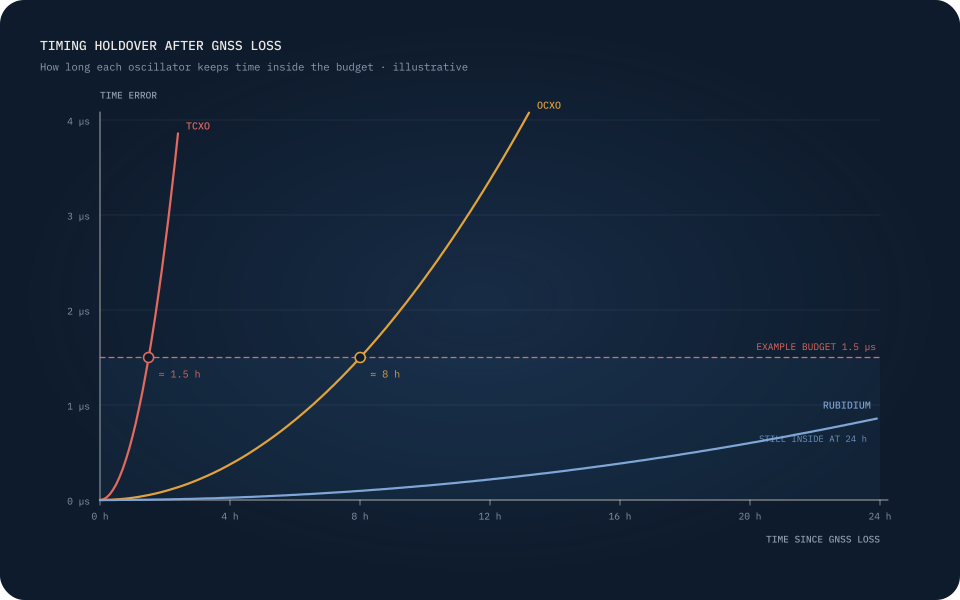
Chart of time error against hours since GNSS loss for three oscillator types, showing the TCXO and OCXO curves crossing a dashed example budget line while the rubidium curve stays below it.
  • time error
  • tolerance
  • outage length

Illustrative

CONTROLS

1 h
1 µs
TIME ERROR
± 0.4 µs
IN TOLERANCE FOR
Whole outage
STATUS
In tolerance

Simulated, with illustrative figures. Runs in your browser; nothing is uploaded.

Assumptions behind the figures
  • Time error x(t) = x0 + y0·t + ½·D·t², starting at x0 = 0, with the offset y0 and ageing D in the same direction (worst case)
  • TCXO: y0 = 1×10⁻⁸, ageing 1×10⁻⁹ per day
  • OCXO: y0 = 1×10⁻¹⁰, ageing 5×10⁻¹¹ per day
  • Rubidium: y0 = 1×10⁻¹², ageing 3×10⁻¹³ per day
  • Temperature swings: ±10 K over 24 h with an assumed sensitivity for each oscillator

HOW IT WORKS

Lock, coast, drift

  1. Step 1: Lock

    With GNSS, the clock is steered to satellite time.

  2. Step 2: Coast

    When GNSS drops out, the oscillator runs alone and slowly drifts.

  3. Step 3: Tolerance

    How long it stays inside your limit depends on its quality and its temperature.

TRY THIS

Things to try

  • Swap a TCXO for a rubidium clock and compare
  • Turn on temperature swings
  • Set your own tolerance and find the hold time
  • Try a week-long outage

MORE

Other demos