How far does a jammer reach?

Set a jammer’s power and distance and see when a receiver loses lock. Free-space maths with illustrative figures.

LIVE DEMO · JAMMING RANGE

LOCK LOST
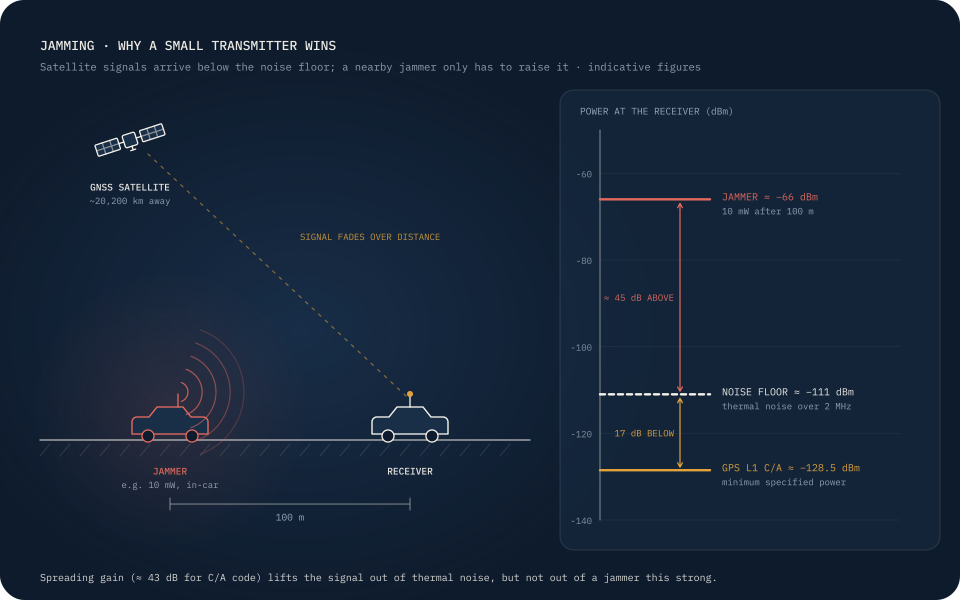
Diagram of a distant satellite, a nearby in-car jammer and a receiver, next to a power scale showing the jammer far above the noise floor and the satellite signal below it.
  • jammer at receiver
  • GNSS signal
  • lock-loss threshold

Illustrative

CONTROLS

10 mW
200 m
JAMMER AT RECEIVER
−72 dBm
J/S RATIO
+56 dB
LOCK
Lost
PATH LOSS
82 dB
LOCK LOST WITHIN
1.2 km

Simulated, with illustrative figures. Runs in your browser; nothing is uploaded.

Assumptions behind the figures
  • GNSS signal at the receiver: −128 dBm
  • Frequency: 1575.42 MHz; antenna gain 0 dBi
  • Standard receiver: degraded at J/S 30 dB, lock lost at 40 dB
  • Robust receiver: degraded at J/S 40 dB, lock lost at 50 dB
  • Antenna nulling removes 20 dB of jammer power

HOW IT WORKS

Why a small transmitter wins

  1. Step 1: Path loss

    Signals weaken with distance, the jammer’s and the satellites’ alike.

  2. Step 2: Compare

    The receiver weighs the jammer against satellite signals that are already below the noise.

  3. Step 3: Lock

    Once jamming exceeds what the receiver’s processing can absorb, it loses lock.

TRY THIS

Things to try

  • Halve the distance and watch the J/S ratio rise by 6 dB
  • Find the distance where a 10 mW jammer stops mattering
  • Turn on antenna nulling and compare the range
  • Compare a car-charger jammer with a 1 W unit

MORE

Other demos